If

Another one of my favourite poems.


“If you can keep your head when all about you
Are losing theirs and blaming it on you,
If you can trust yourself when all men doubt you,
But make allowance for their doubting too;
If you can wait and not be tired by waiting,
Or being lied about, don’t deal in lies,
Or being hated, don’t give way to hating,
And yet don’t look too good, nor talk too wise:

If you can dream—and not make dreams your master;
If you can think—and not make thoughts your aim;
If you can meet with triumph and disaster
And treat those two impostors just the same;
If you can bear to hear the truth you’ve spoken
Twisted by knaves to make a trap for fools,
Or watch the things you gave your life to, broken,
And stoop and build ’em up with worn-out tools:

If you can make one heap of all your winnings
And risk it on one turn of pitch-and-toss,
And lose, and start again at your beginnings
And never breathe a word about your loss;
If you can force your heart and nerve and sinew
To serve your turn long after they are gone,
And so hold on when there is nothing in you
Except the Will which says to them: ‘Hold on’

If you can talk with crowds and keep your virtue,
Or walk with Kings—nor lose the common touch,
If neither foes nor loving friends can hurt you,
If all men count with you, but none too much;
If you can fill the unforgiving minute
With sixty seconds’ worth of distance run,
Yours is the Earth and everything that’s in it,
And—which is more—you’ll be a Man, my son!”

– Rudyard Kipling

Life and Reinforcement Learning

This article explores the closeness of life, and reinforcement learning, a popular machine learning branch. Although reinforcement learning has grown by drawing concepts, and terminologies from life and neuroscience, I think it’s good to compare reinforcement learning algorithms and life, from which they are derived.

Reinforcement learning is a subset of machine learning which deals with an agent interacting in an environment and learning based on rewards and punishments from the environment. This falls under the broader umbrella of artificial intelligence.

After a group of researchers realized the potential of reward-based learning, a resurgence happened in the late 1990s. Thus, after a number of failed approaches over decades, this interaction and reward-based learning approach seems promising to achieve our dream of artificial general intelligence.

For those who are unfamiliar, this idea is similar to how babies learn to walk.

They make random steps, fall from unstable positions, and finally, they learn to stand upright and walk by understanding the hidden dynamics arising from gravity, and mass. Usually, no positive reward is given to the baby for walking. But the objective is to receive the least negative reward. In this case, least damage to the body while learning to walk.

Trial and error they say.

That does not mean the learning is random. It means that the path to optimal behaviour is not a one-shot solution but happens through a series of interactions with the environment and learning from feedback.

All this happens without higher cognition and reasoning. That’s the power of feedback! The learning is reinforced with the positive and negative feedbacks received from interactions. Once, the optimal behaviour is understood, our brain exploits and repeats the learned behaviour.

Recently, there has been a number of additions to the existing repository of reinforcement learning algorithms. But to understand the framework of reinforcement learning, there is a popular toy example of optimally navigating in a grid world (say 5×5). The grid world has discrete states with obstacles, a starting point, and a terminal point. The agent is randomly initialized in a state and the goal is to optimally navigate to the terminal state. The agent can take actions such as moving left, right, up, and down. The agent receives a reward of -1 for entering the next state, -10 for hitting the obstacles, and +100 for reaching the terminal state. Thus, the objective is to navigate to the goal position in the shortest possible distance without hitting the obstacles.grid
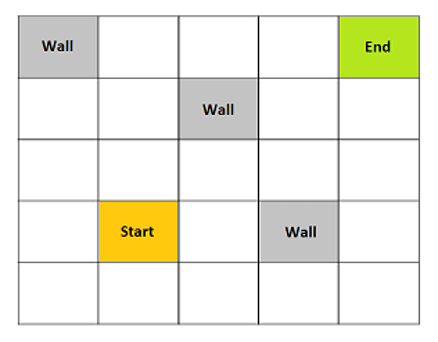
This problem, of course, is not difficult to understand and solve. The solution is simple when the value of every state is known. This is a metric that defines how good it is to be in a particular state. Based on this, we can formulate an optimal policy or behaviour.

But how similar is life when compared to this problem of reinforcement learning ?

Much. Except that we don’t have many algorithms, and episodes to establish an optimal behaviour. Essentially, every action in life is about making optimal decision. Given a state, what is the best policy I can follow?

We, as humans, like reinforcement learning agents, are left in a maze like grid world called life. The environment is highly stochastic and time-based. The starting state is biased, and the terminal state is uncertain. By biased starting state, I mean you can either be born in a better place with better opportunities or a worst place with no opportunities. By uncertain terminal state, I mean that death is possible anytime. However, the agents are allowed to make optimistic assumptions throughout the episode.

photo-1491485066275-97da4e681cb8

Before exploring the environment, the first step for the agent is to set the rewards. In reinforcement learning, reward design is usually a tricky process. If the rewards are poorly designed, the agent might be learning something else that is not intended.

How do humans set rewards in their life? Every person has their own way of defining their rewards. In most cases, it is to achieve prolonged happiness or satisfaction by setting goals, sub-goals and achieving them before the episode ends. Most humans follow hedonistic approach by setting immediate pleasures as their rewards. But focusing only on the short-term immediate rewards may not result in an optimal policy in the long run. 

But what policy to follow when the agent has defined a goal? Exploit or Explore or combinations? What about the ethical issues that arise while following a policy? What is right and wrong? No one knows. As said before, no one has a golden algorithm for these questions. The environment is highly stochastic where even the episode length, and terminal state are uncertain.

Some agents look far into the future, estimate the value function of each state regularly, and formulate their policy accordingly. They understand the importance or value of every stage of life, and take the optimal action. They exploit, and reach their goals before the end of episode, and receive a huge positive reward. Success, they call it.

Some agents take this success to the next level by finding the exact explore-exploit trade-off point. In addition to the known rewards, they discover rewards that were previously unknown to the agents who just exploit.

Unfortunately, many agents keep exploring the environment without understanding the importance of goal setting, and value function estimation. They make random moves, keep hitting the obstacles, and die without a policy towards the goal state. Their episode ends with a high negative reward.

Most agents achieve partial success by reaching a sub-optimal point. They manage to achieve few sub-goals but fail to reach their goals by making wrong assumptions, incorrect value function estimation, and by the wrath of stochasticity of the environment. Something is better than nothing, they say.

But is it possible to formulate a global optimal behaviour for this environment?

I don’t think so. The large number of hidden factors contributing to the stochasticity of the environment makes it really hard to come up with a single golden policy which assures success.

And the worst part, unlike the reinforcement learning agent, which runs millions of episodes to learn an optimal behaviour, we just have one episode.

Yes, only one. That’s unfair. But the good part is, you can learn from the episodes of other agents. If you are willing to.

– Pradeep


Image Sources :

1. http://pavbca.com/
2. https://unsplash.com/

Further Reading :

Reinforcement Learning : An Introduction – Richard S. Sutton and Andrew G. Barto

 

Go All The Way

Often, the universe throws a dilemma to those who give all their life for their dreams. It’s a fork that you come across in your journey along the road of life. The dilemma is to choose the right direction. You are free to choose any. But the right decision will separate you from the rest of the herd. 

“Should I stop trying or keep pushing the limits?”

This is answered in one of my favourite poems by Charles Bukowski. 


“If you’re going to try, go all the way.
Otherwise, don’t even start.

If you’re going to try, go all the way.
This could mean losing girlfriends, wives, relatives, jobs, and maybe even your mind.

Go all the way.
It could mean not eating for three or four days.
It could mean freezing on a park bench.
It could mean jail.
It could mean derision, mockery, isolation.

Isolation is the gift.
All the others are a test of your endurance, of how much you really want to do it.
And, you’ll do it, despite rejection and the worst odds.
And it will be better than anything else you can imagine.

If you’re going to try, go all the way.
There is no other feeling like that.
You will be alone with the gods, and the nights will flame with fire.

Do it. Do it. Do it. Do it. All the way.

Go all the way.

You will ride life straight to perfect laughter.
It’s the only good fight there is.”

– Charles Bukowski


Original Poem : Roll the Dice

The Dead End

How does it feel to give up on something that drove you every second?

Something that gave you purpose to fight all these years.
Something that consumed your time, energy, and sleep.
Something into which you have put all your soul.

You have come too far. You always thought that giving up was never an option. But now you have reached the end.

“The Dead End”

You have reached the end of dreams and stranded in the middle of nowhere. The road of dreams has ended abruptly. Your mind is now liberated from the fickle thoughts. No more switching over between “Never give up” and “It’s okay to give up”. You take time to give in and accept this dead end.

You see the sky getting dark. This time, the night closes in permanently.

You see the monsters peeping out from the bushes.
Grinning…Howling…
Waiting to devour you.

You look into their glowing eyes and see them having a sense of relief. They no longer have a warrior to fight with. They are waiting to celebrate your failure and tell you that some dreams are always meant to be dreams

You are about to witness the most painful thing where your dreams die while you are still alive, while you are still fighting. That feel of powerlessness at the merciless hands of monsters. 

You have put up a great fight all these years. Fighting them all along the road of dreams. And now you realize there is no route anymore. You stare at the dead end. The dead end sympathizes with you. It curses itself for not providing a path.

You have nothing left in you to fight. And you have no reason to fight for. Gone are the days when you fought till the dusk and survived to fight the same battle the next day. Now that there is no road, what would you fight for? You have completely lost the purpose.

As time goes, darkness surrounds you. The monsters close in. They get ready to knock off your guts one by one. Till the point when you succumb and become a hopeless soul. 

You laugh at them and take out your sword for one last time. You know the monsters might overwhelm you and defeat. But they can never take away your fighting spirit.

That belongs to your soul.

– Pradeep


Image Source : https://www.wallpaperflare.com/

Is There God?

I have had several questions in my childhood. I found answers to most of them. But not to this question.

Is there God?

My mind always exploded whenever I realized that there is nothing called ‘forever’. One day, I will vanish like a speck of dust leaving behind everything including my memories.

Every night before sleep, I used to ask myself, ‘I know one day I will die. But is it possible for me to stay in an eternal world? Atleast where my consciousness can stay forever. If such a place exists, who would have created that? And who else would live there? Is it what they call God and heaven?’

Life on Earth was created more than 3.5 billion years ago. Yet, to this day, no one has ever given a clear, objective answer to this question. Its funny when people claim that their religion is ‘the oldest’. Unfortunately, the numbers they claim are peanuts. A 2000, a 5000 or even a 10,000 year old religion becomes trivial when we consider how long we are on this planet as a species. I understand that having a way of life through religions is important. But it is even more important to question our existence.

I have come across a plethora of philosophies and religious texts which claim God’s existence and characteristics. Most of them point to the following quotes.

God is Inside You. 
God is in Heaven.
Devotion is God.
Nature is God.
Love is God.
Kindness is God.
Dedication is God.

All these sound nice. But they don’t answer the original question – is there God? The answer to this question is ‘Yes or No’. Not inside, outside or love. If there is no God, then there are no questions. It means that the universe exists by itself and life on Earth was created as a result of probabilties. The result of randomness could have sparked life in the universe. But what if God exists and life was not created out of randomness but for a purpose? This leads us to a new subset of questions.

“What are His characteristics? Why is He not revealing Himself? What are His powers? What created God? What is the purpose of life?”

Every religion tries to bypass the complexity of such questions by providing oversimplified and vague answers such as “He is eternal. He will reveal Himself when the time comes. He has infinite powers. He cannot be created or destroyed.”

Again, all these sound nice. But they don’t answer the questions about God and man. It is really hard to answer such complicated questions with simple explanations. For instance, try to understand what is eternal?

Eternal is something which has no end or origin. It exists forever. But what is something that has no beginning or an end? Is something like that even possible? Again, if something like that exists, how was it created in the first place? May be by someother higher forms of living? If so, who created that higher form of living? Can we attain that higher form of living?

This paradox puts us in an infinite loop of “who created what and how was that created.” Such is the case of several other answers given by various religions. Human brain has been trained to think of everything as bounded and symmetrical. “Good – Bad, Light – Dark, Heaven – Hell, Life – Death, Begin – End, God – Demon.”

But whenever we encounter a difficult question and unable to think any further, we just break the boundaries and symmetries. That’s how religions define the existence and characteristics of God.

“Eternal, Omnipresent, Infinite, Fathomless.”

Another classic way theologists prefer to explain God is “by riding on the back of pseudoscience and scientific terminologies”. Often, people fall for terminologies such as mass, matter, energy, vibes, aura, space, cosmic radiations. One such famous quote is, “The concept of time, space, and matter emerged only after the bigbang. He is beyond space, time, and matter.”

This sounds convincing. But even if He is beyond all these, there are still questions to be answered. “What is the point of all these life forms? Why does the universe behave the way it does? Do we really need the presence of a creator to justify this complex behaviour of the universe? Are we limited by the capacity to think?”

There are no convincing answers to these. You can claim whatever you want as no one knows the answer. The existing theological arguments lead us to question the very basic ideology.

“Did God really create us? or We have created the Gods?”

I often think of this question as an unsolved puzzle given to a bunch of students in a class. Suddenly, some students claim that they found the answer and their solution is unique or only one. Instead of explaining their methods and instigating further research, they order everyone else to follow their approach and write the same answer. 

Likewise, in the past, several people from different countries have tried to describe God. But none of them seem to have succeeded. Instead of taking the philosophies further and questioning our existence, humanity was satisfied with the broken descriptions. “People were claimed to be Gods. The philosophies were propagated ‘through time’ as ‘religions’. People were made to follow the religions. And the religions were protected by the people.”

“With the advent of every new religion, the fear of suppression by one over the other increased. And as the fear of suppression rose, the faith in the religions were bolstered further to protect them from destruction.”

This whole attempt to describe God seems to be the biggest debacle in human evolution.

As a result, the question is still left unanswered.
Is there God?

I don’t know the answer now. But I hope I will find one day. But till then, there is no harm in assuming the existence of a good thing, a God, a universal spirit.

“Atleast for the sake of good hearted and weak-minded people who need a support to live their daily lives.”

– Pradeep


Image Source : https://zersey.com/

The Gray World

At some point in life, you enter a death spiral and end up in a gray world. The Gory, Gray world, filled with broken dreams, shattered hopes, and lost faith. You didn’t choose it. You know this world existed. You just denied to acknowledge it’s existence. But in the end, you were forced to accept it’s existence.

No more sharp difference between white and black. Everything seems to be painted gray. You can no longer tell the difference between a dream and a reality. A dream feels as real as a reality and the reality just feels like a bad dream.

You feel numb in reality and experience pain in dreams. You can’t differentiate a dream and a reality using pain or senses. Your senses don’t help in differentiating them anymore. Neither your feelings. You don’t know if you are alive or dead. Much similar to Cotard’s delusion. You doubt your own existence.

You wonder, how did I end up here?

It all started with the dreams. The ones built by your thoughts. Built meticulously,
One by One,
Day by Day,
For Years.

Concealed in the deepest place of your mind for years. You were astonished by what you built over the years. Only to see it fade away and get lost in the dawn of reality.

You know its happening. But you don’t want it to be happening. You have had nightmares. Similar nightmares. The nightmare of losing your dreams in the wake of reality. It feels strange when your nightmares come true. You have had nightmares in dreams. But never in reality. The moment you get to experience them for real, becomes the moment you lose your sanity to distinguish a dream and a reality.

After all this, a small portion of you in that deepest place of your mind that helped building the dream, still hopes for an alternative reality.

You start wondering. You wish you were only dreaming.

But you weren’t. You just lost the ability to differentiate them.

– Pradeep


Image Source : https://www.wallpaperup.com/

The Girl who was Always There

She was always with me.

I never knew she meant so much to me. Sometimes I have not even noticed her existence around me. It might sound very rude. But that’s how we were. We were good friends. We never had a formal chat.  At times, I have shouted at her, pinched, poked and even pulled her hair. I don’t remember the last time I called her respectfully by name. But some part of me always cared for her.  

I don’t remember the last time we went out for dinner together. But somehow my heart believed that she was always going to be with me. We have been together for more than two decades and now I realize that staying together for long doesn’t make it permanent. When something stays with you for a long time, your heart presumes it to be permanent. Like something that’s always there for you. 

It is not true. It was never true. It was not meant to be there forever with you. Your mind knows this bitter truth. But your heart doesn’t want to know what the mind knows. And there comes a point in life where you have to let go your emotions. Let go the girl who was always there for you unconditionally.

The common advice is to move on. 

But I have never really mastered this word – ‘moving on’. All my life I have never really moved on. I just lose myself in the immense flow of time. I leave my memories behind. So that they can no longer haunt me. Now she has joined the club of people who haunt me. I realize all these while having a hot cup of coffee without any disturbance. There was always that someone to make me a coffee. There was always that someone to disturb me by striking a pointless conversation. And now without that someone, I see the concept of nothingness. Null, empty or void whatever you name it.

I have always considered her a disturbance and failed to express my love for her. But I don’t think that’s mandatory. I don’t need to prove my love for her. She knows it and I know it.

Sometimes words are insufficient . We don’t have words to describe complex feelings. Sometimes you feel like damaged, broken, crying, shouting, and laughing at the same time. Words are of no use unless someone coins new words for such complex feelings.

I’m nothing new to this reality of losing my best people. Now all I have to do is to let go her memories. They will be buried somewhere deep in the dark. This is one exceptional scenario where I consider memory loss as an extraordinary gift.

Perhaps, memory loss is the only natural cure to leave someone you love.

Bon voyage sister.

-Pradeep


Image Source : https://www.wallpaperup.com/

The Effects of Concealed Qs

This article is about the four Qs that our education failed to teach us.

While we were asked to compete with the fellow students for higher IQ, we were totally masked from the list of Qs essential for human life. We failed to understand the importance to balance the 4Qs and their role in shaping our society.

I remember learning 4Ps in marketing (Price, Product, Place, Promotion) and 4Rs in waste management (Reduce, Reuse, Recycle, Recover). But the in-between letter was never taught as it had no technical importance or perhaps, someone did not like the letter Q.

There are actually four Qs essential for a person’s well being.

1. IQ
2. EQ
3. PQ
4. CQ

Some people provide a modified version of the four Qs – Intelligence, Emotional, Physical, and Spiritual. But all of them focus almost on the same aspects.

1.Intelligence Quotient :

IQ is a measure of your intelligence. It includes your reasoning, logical, and memory skills. It’s not always proportional to success. We have a myriad of success stories of people who have poor IQ or intelligence and became successful in life.

But we have never really found a holistic approach to define intelligence. IQ and grades are still the fundamental and universal measures of intelligence. And I never really understood the way they define intelligence. Whenever I see a news stating that a 10 year old or a 12 year old has more IQ than X, Y, or Z, I wonder. Intelligence is definitely not about solving a 2 hour question paper on finding patterns/reasoning and giving it a score. And comparing this score against Einstein or Bill Gates is not how you define intelligence.

Exam scores only indicate that the person had prepared well for the exam you conducted.  

2.Emotional Quotient :

It focuses on values, beliefs, and conscience that are essential for inner peace and well being. People are completely unaware of the terminologies used to describe EQ. Perhaps, the reason why our society is spoiled to a greater extent is the lack of emphasis on EQ. EQ emphasizes on self control, empathy, and social skills.

Empathy – situational awareness and understanding each other’s feelings. We lack empathy. We never put ourselves in other’s shoes. One could relate every common sentence to this terminology.

Oh..that poor man was hit by a car..
Oh..she was stabbed brutally..
Oh..that guy was murdered..pathetic…

If you pay close attention to all those adjectives and pronouns, they only describe their misery. We don’t really care who died or who did. Who actually does these crimes? They are the same people who had education like us.

We are happy to share our sympathy for the victims. But we really don’t care and respect other’s feelings. We don’t think of the root cause and solution for such incidents. Instead, we consider ourselves to be lucky, and the victims to be the unfortunate ones.

3.Passion Quotient :

It focuses on passion. Sacrificing all your time and energy for something. That something which would give meaning to your life. Lack of emphasis on passion has turned our society into a huge, messed up jig-saw puzzle with people misplaced in their profession.

4.Cultural Quotient :

It tells about race, gender, culture, and sex. CQ is essential to get involved in a cross-cultural environment and to respect the fellow human being. Lack of proper CQ is the reason for increased attacks on people based on religion, race, and sex.


If we can evolve to live without any ethics, we don’t need conscience. Without conscience, we are just like every other animal or an object on this planet. 

Education without ethics is useless.

– Pradeep

The Untold Story of Office Printers

Most of us use office printers for printing confidential documents and personal files without knowing the security risks. It is possible to track the printer usage. Even failed to print documents can be seen !

There are a number of ways.

1.There are few employee monitoring software which can provide the list of documents you printed.

http://www.surveilstar.com/printing-logs.html

2.By default, all printing events are written to the system log file.
 
https://technet.microsoft.com/en-us/library/cc758186%28v=ws.10%29.aspx

3.It is also possible to recover data from the printer.

It depends on which printer you are using.

Most multi-function printers or what is called MFPs have hard drives that record and store data. Most printers overwrite the data. But still, printing a confidential document poses a serious risk when you resell the printer.

How does it work ?

The digital information is transmitted to the printing device through a computer over a network. This data is stored on the hard disk so the device can print quickly and multi task.

How to know if your printer has a hard drive ?

1. Identify the printer company and model.
2. Go to their website and check whether hard disk in that model is standard or optional.
3. If its optional, there are some methods to check the presence of hard disk.

Think before printing your personal files using office printers.

– Pradeep

Why Should You Not Feel Sad?

There are some reasons to why you should not feel sad.

Common reasons :

1.Spoils good mood.
2.Highly contagious.
3.Weakens your mind.

Primary reasons :

1.We don’t have time to be sad.
2.It can’t solve problems.
3.It can never solve problems !

Never be sad of failure.
Never be sad of what you had lost.
Never be sad of what went wrong.
Never be sad of someone who left you.
Forget your happy-sad cycle. 

Never think that being sad will soon bring happiness. Happiness is not the opposite of sadness. Someone has misguided people by this cycle. 

It is not an antonym.
It is not part of a cycle.
But a state of mind.
You are happy, if you believe you are happy.
Stay happy.

– Pradeep