Black Seas of Infinity

The most merciful thing in the world, I think, is the inability of the human mind to correlate all its contents. We live on a placid island of ignorance in the midst of black seas of infinity, and it was not meant that we should voyage far. The sciences, each straining in its own direction, have hitherto harmed us little; but some day the piecing together of dissociated knowledge will open up such terrifying vistas of reality, and of our frightful position therein, that we shall either go mad from the revelation or flee from the light into the peace and safety of a new dark age.

– H.P. Lovecraft

The Broken Promise

Its not easy to write this, Father.

This writing was supposed to stay in my diary forever. But I thought this would serve as a bottled message for some souls seeking refuge. Travelling across the vast digital oceans, it might reach someone in need.


I always considered us to be special. Blessed by the gods.
To lead an ideal, good and happy life. Believing all the good quotes thrown at me.

Do good, good thing will come back.
God helps those who help.
God saves the good ones.

Good things take time.

But turns out we were not that special after all. We are a mere dust floating in space. To be blown away anytime. Constantly living under the mercy of nature.  And if nature says its time, we are washed away like the hopeless little rocks under the immense force of a flood. No one knows where it goes.

I was ready for everything in life. Prepared to take on whatever is thrown at me. But I wasn’t ready for this. I wasn’t prepared to see you in a room filled with lifeless bodies. 

Because you had promised me.

You had promised that you will stay with me and watch me grow. You said we will grow together, play with dogs, play with my kids. Somehow that’s the foundation I built myself upon and was never prepared to see you leave soon. 

But I was wrong. We were wrong. We never understood nature. Nature doesn’t care how good you are. It doesn’t care about your place on earth. It doesn’t care about your responsibilities. It doesn’t care about consequences. There are no consequences for nature. It’s only for the mortals. We both ended up building illusions on top of the illusion of life.

May be its another day for the hospital. Another day for the world. But not for me. My world stopped that day while others were still running on that day. You don’t know how many times I wished it was a bad dream. But it wasn’t.

Some lessons are learnt in the most cruelest ways.

Universe will let you down.
Gods won’t save you at the last moment.
Miracles don’t happen.
Promises will be broken
.

I don’t care about the gods. All I think about is the nature. I have respect for nature now. But I’m not afraid of it. You have given me all the skills to survive in this wild nature, Father.

I’m sure I was the only thing you thought about when your life flashed for the last time before leaving the body. Don’t worry. In case you are seeing me from other dimensions, I love you. I will keep your flame of hope alive. May be its not as bright as it used to be. But I will keep it alive. Someday, some human might need it. I will pass it along.

– Pradeep

The Panacea

Every time I see someone complaining about all the chaos in the world, I just think of one solution.

Forget all the mistakes of our past. Let’s open a blank page, a fresh start. Let’s begin from a new generation.

“Show them how big our universe is. Teach them every day and night about its vastness. Let them understand how insignificant we are. Let them realize that we are not meant to go extinct on this planet. But remind them that this is our only home right now.”

This idea is beautifully explained by Carl Sagan in one of his books.


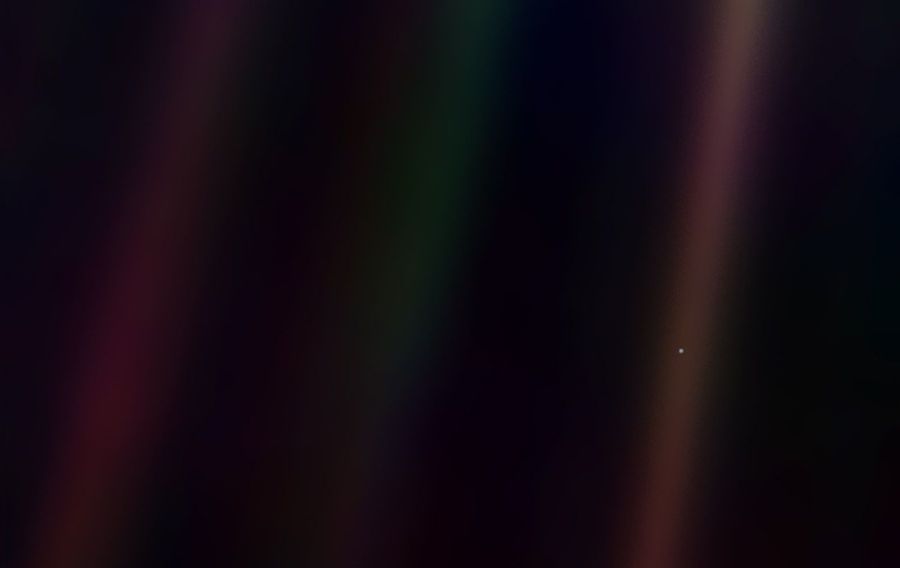
“Look again at that dot. That’s here. That’s home. That’s us. On it everyone you love, 
everyone you know, everyone you ever heard of, every human being who ever was, lived out their lives. 

The aggregate of our joy and suffering, thousands of confident religions, ideologies, and economic doctrines, every hunter and forager, every hero and coward, every creator and destroyer of civilization, every king and peasant, every young couple in love, every mother and father, hopeful child, inventor and explorer, every teacher of morals, every corrupt politician, every “superstar,” every “supreme leader,” every saint and sinner in the history of our species lived there – on a mote of dust suspended in a sunbeam.

The Earth is a very small stage in a vast cosmic arena. Think of the rivers of blood spilled by all those generals and emperors so that, in glory and triumph, they could become the momentary masters of a fraction of a dot. Think of the endless cruelties visited by the inhabitants of one corner of this pixel on the scarcely distinguishable inhabitants of some other corner, how frequent their misunderstandings, how eager they are to kill one another, how fervent their hatreds.

Our posturings, our imagined self-importance, the delusion that we have some privileged position in the Universe, are challenged by this point of pale light. Our planet is a lonely speck in the great enveloping cosmic dark. In our obscurity, in all this vastness, there is no hint that help will come from elsewhere to save us from ourselves.

The Earth is the only world known so far to harbor life. There is nowhere else, at least in the near future, to which our species could migrate. Visit, yes. Settle, not yet. Like it or not, for the moment the Earth is where we make our stand.

It has been said that astronomy is a humbling and character-building experience. There is perhaps no better demonstration of the folly of human conceits than this distant image of our tiny world. To me, it underscores our responsibility to deal more kindly with one another, and to preserve and cherish the pale blue dot, the only home we’ve ever known.”

– Carl Sagan


Book :

Pale Blue Dot : A Vision of the Human Future in Space

Image :

https://www.jpl.nasa.gov/spaceimages/details.php?id=PIA00452

Hmmm…🤔

I had this crazy thought when I was a kid. 

“Before I die, is it possible to cover every piece of land on this planet just by walking?”

Let’s do a rough math.

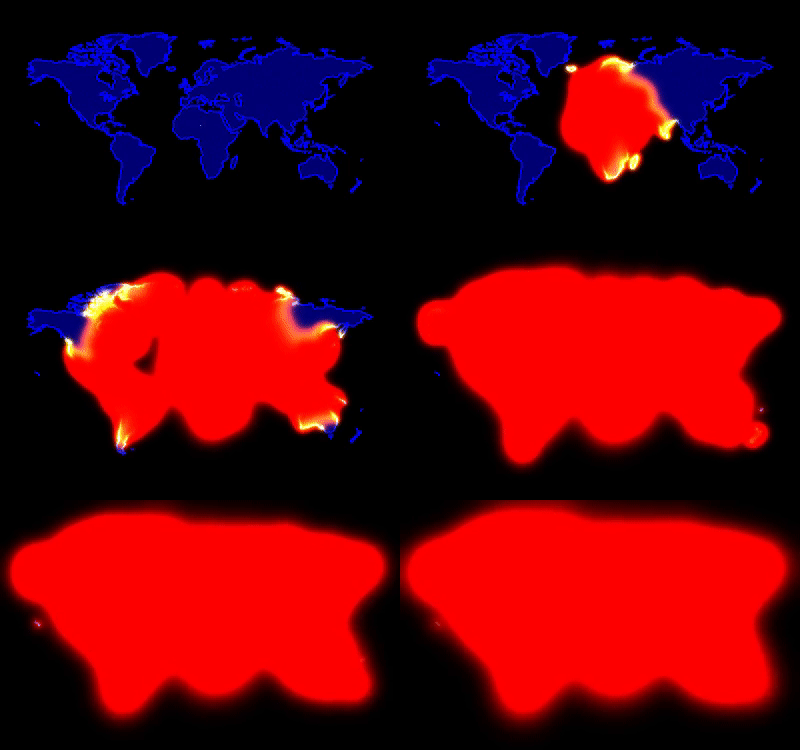
If you consider only the landmass, it is 148.94 million sq km. Consider a 1 sq m bounding box. Let’s assume that this box represents our position and moves at 1 sq m per second. Ignore constraints like sleep, food, and crossing the ocean.

To cover the entire landmass, it would take us approximately 4722.85 millenia 😦

 World

– Pradeep


Source :

https://www.cia.gov/library/publications/the-world-factbook/geos/print_xx.html

Visualization : Inspired by the following links

1. http://maxberggren.se/2014/11/27/model-of-a-zombie-outbreak/
2. https://github.com/Zulko/moviepy

Eternal Bliss

One of my favourite philosophies. 

The following lines are taken from Nirvana Shatakam by Adi Shankara. It attempts to describe the nature of God. If God exists, what will be his/her/it’s attributes. This also addresses the question of ‘What lies beyond all this reality?’

This uses the concept of nothingness and eternal bliss to answer such questions.

This should not be confused with nihilism.


“I am not the mind, the intellect, the ego or the memory,
I am not the ears, the skin, the nose or the eyes,
I am not space, not earth, not fire, water or wind,
I am the form of consciousness and bliss,
I am the eternal Shiva.

I am not the breath, nor the five elements,
I am not matter, nor the 5 sheaths of consciousness
Nor am I the speech, the hands, or the feet,
I am the form of consciousness and bliss,
I am the eternal Shiva.

There is no like or dislike in me, no greed or delusion,
I know not pride or jealousy,
I have no duty, no desire for wealth, lust or liberation,
I am the form of consciousness and bliss,
I am the eternal Shiva.

No virtue or vice, no pleasure or pain,
I need no mantras, no pilgrimage, no scriptures or rituals,
I am not the experienced, nor the experience itself,
I am the form of consciousness and bliss,
I am the eternal Shiva.

I have no fear of death, no caste or creed,
I have no father, no mother, for I was never born,
I am not a relative, nor a friend, nor a teacher nor a student,
I am the form of consciousness and bliss,
I am the eternal Shiva.

I am devoid of duality, my form is formlessness,
I exist everywhere, pervading all senses,
I am neither attached, neither free nor captive,
I am the form of consciousness and bliss,
I am the eternal Shiva.”

– Adi Shankara


Personally, I have never realized ‘True Nothingness’ and ‘Eternal Bliss’.

Is that possible? Even if you have broken the shackles of reality, when you think you have attained nothingness or eternal bliss, your thoughts still exist.

Sometime ago, a friend of mine pulled me into the debate of whether thoughts create the thinker or the thinker creates thoughts. The result was inconclusive.

When a life exists, it manifests in a body. The mind inside the body creates thoughts, and the thoughts in turn give an identity to the body and surroundings. It doesn’t matter what creates what. As long as there are thoughts spread out as waves, there is no true nothingness.

To me, the one who has attained true nothingness and eternal bliss will no longer be in contact with any life form.

Neither he/she will be aware of their existence as a life form.


Sources :

1. http://www.sankaracharya.org/nirvana_shatkam.php
2. https://en.wikipedia.org/wiki/Atma_Shatkam

Image Source : 

http://wallpaperswide.com/


Life and Reinforcement Learning

This article explores the closeness of life, and reinforcement learning, a popular machine learning branch. Although reinforcement learning has grown by drawing concepts, and terminologies from life and neuroscience, I think it’s good to compare reinforcement learning algorithms and life, from which they are derived.

Reinforcement learning is a subset of machine learning which deals with an agent interacting in an environment and learning based on rewards and punishments from the environment. This falls under the broader umbrella of artificial intelligence.

After a group of researchers realized the potential of reward-based learning, a resurgence happened in the late 1990s. Thus, after a number of failed approaches over decades, this interaction and reward-based learning approach seems promising to achieve our dream of artificial general intelligence.

For those who are unfamiliar, this idea is similar to how babies learn to walk.

They make random steps, fall from unstable positions, and finally, they learn to stand upright and walk by understanding the hidden dynamics arising from gravity, and mass. Usually, no positive reward is given to the baby for walking. But the objective is to receive the least negative reward. In this case, least damage to the body while learning to walk.

Trial and error they say.

That does not mean the learning is random. It means that the path to optimal behaviour is not a one-shot solution but happens through a series of interactions with the environment and learning from feedback.

All this happens without higher cognition and reasoning. That’s the power of feedback! The learning is reinforced with the positive and negative feedbacks received from interactions. Once, the optimal behaviour is understood, our brain exploits and repeats the learned behaviour.

Recently, there has been a number of additions to the existing repository of reinforcement learning algorithms. But to understand the framework of reinforcement learning, there is a popular toy example of optimally navigating in a grid world (say 5×5). The grid world has discrete states with obstacles, a starting point, and a terminal point. The agent is randomly initialized in a state and the goal is to optimally navigate to the terminal state. The agent can take actions such as moving left, right, up, and down. The agent receives a reward of -1 for entering the next state, -10 for hitting the obstacles, and +100 for reaching the terminal state. Thus, the objective is to navigate to the goal position in the shortest possible distance without hitting the obstacles.grid
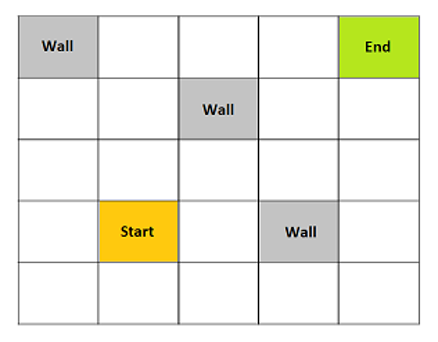
This problem, of course, is not difficult to understand and solve. The solution is simple when the value of every state is known. This is a metric that defines how good it is to be in a particular state. Based on this, we can formulate an optimal policy or behaviour.

But how similar is life when compared to this problem of reinforcement learning ?

Much. Except that we don’t have many algorithms, and episodes to establish an optimal behaviour. Essentially, every action in life is about making optimal decision. Given a state, what is the best policy I can follow?

We, as humans, like reinforcement learning agents, are left in a maze like grid world called life. The environment is highly stochastic and time-based. The starting state is biased, and the terminal state is uncertain. By biased starting state, I mean you can either be born in a better place with better opportunities or a worst place with no opportunities. By uncertain terminal state, I mean that death is possible anytime. However, the agents are allowed to make optimistic assumptions throughout the episode.

photo-1491485066275-97da4e681cb8

Before exploring the environment, the first step for the agent is to set the rewards. In reinforcement learning, reward design is usually a tricky process. If the rewards are poorly designed, the agent might be learning something else that is not intended.

How do humans set rewards in their life? Every person has their own way of defining their rewards. In most cases, it is to achieve prolonged happiness or satisfaction by setting goals, sub-goals and achieving them before the episode ends. Most humans follow hedonistic approach by setting immediate pleasures as their rewards. But focusing only on the short-term immediate rewards may not result in an optimal policy in the long run. 

But what policy to follow when the agent has defined a goal? Exploit or Explore or combinations? What about the ethical issues that arise while following a policy? What is right and wrong? No one knows. As said before, no one has a golden algorithm for these questions. The environment is highly stochastic where even the episode length, and terminal state are uncertain.

Some agents look far into the future, estimate the value function of each state regularly, and formulate their policy accordingly. They understand the importance or value of every stage of life, and take the optimal action. They exploit, and reach their goals before the end of episode, and receive a huge positive reward. Success, they call it.

Some agents take this success to the next level by finding the exact explore-exploit trade-off point. In addition to the known rewards, they discover rewards that were previously unknown to the agents who just exploit.

Unfortunately, many agents keep exploring the environment without understanding the importance of goal setting, and value function estimation. They make random moves, keep hitting the obstacles, and die without a policy towards the goal state. Their episode ends with a high negative reward.

Most agents achieve partial success by reaching a sub-optimal point. They manage to achieve few sub-goals but fail to reach their goals by making wrong assumptions, incorrect value function estimation, and by the wrath of stochasticity of the environment. Something is better than nothing, they say.

But is it possible to formulate a global optimal behaviour for this environment?

I don’t think so. The large number of hidden factors contributing to the stochasticity of the environment makes it really hard to come up with a single golden policy which assures success.

And the worst part, unlike the reinforcement learning agent, which runs millions of episodes to learn an optimal behaviour, we just have one episode.

Yes, only one. That’s unfair. But the good part is, you can learn from the episodes of other agents. If you are willing to.

– Pradeep


Image Sources :

1. http://pavbca.com/
2. https://unsplash.com/

Further Reading :

Reinforcement Learning : An Introduction – Richard S. Sutton and Andrew G. Barto

 

Is There God?

I have had several questions in my childhood. I found answers to most of them. But not to this question.

Is there God?

My mind always exploded whenever I realized that there is nothing called ‘forever’. One day, I will vanish like a speck of dust leaving behind everything including my memories.

Every night before sleep, I used to ask myself, ‘I know one day I will die. But is it possible for me to stay in an eternal world? Atleast where my consciousness can stay forever. If such a place exists, who would have created that? And who else would live there? Is it what they call God and heaven?’

Life on Earth was created more than 3.5 billion years ago. Yet, to this day, no one has ever given a clear, objective answer to this question. Its funny when people claim that their religion is ‘the oldest’. Unfortunately, the numbers they claim are peanuts. A 2000, a 5000 or even a 10,000 year old religion becomes trivial when we consider how long we are on this planet as a species. I understand that having a way of life through religions is important. But it is even more important to question our existence.

I have come across a plethora of philosophies and religious texts which claim God’s existence and characteristics. Most of them point to the following quotes.

God is Inside You. 
God is in Heaven.
Devotion is God.
Nature is God.
Love is God.
Kindness is God.
Dedication is God.

All these sound nice. But they don’t answer the original question – is there God? The answer to this question is ‘Yes or No’. Not inside, outside or love. If there is no God, then there are no questions. It means that the universe exists by itself and life on Earth was created as a result of probabilties. The result of randomness could have sparked life in the universe. But what if God exists and life was not created out of randomness but for a purpose? This leads us to a new subset of questions.

“What are His characteristics? Why is He not revealing Himself? What are His powers? What created God? What is the purpose of life?”

Every religion tries to bypass the complexity of such questions by providing oversimplified and vague answers such as “He is eternal. He will reveal Himself when the time comes. He has infinite powers. He cannot be created or destroyed.”

Again, all these sound nice. But they don’t answer the questions about God and man. It is really hard to answer such complicated questions with simple explanations. For instance, try to understand what is eternal?

Eternal is something which has no end or origin. It exists forever. But what is something that has no beginning or an end? Is something like that even possible? Again, if something like that exists, how was it created in the first place? May be by someother higher forms of living? If so, who created that higher form of living? Can we attain that higher form of living?

This paradox puts us in an infinite loop of “who created what and how was that created.” Such is the case of several other answers given by various religions. Human brain has been trained to think of everything as bounded and symmetrical. “Good – Bad, Light – Dark, Heaven – Hell, Life – Death, Begin – End, God – Demon.”

But whenever we encounter a difficult question and unable to think any further, we just break the boundaries and symmetries. That’s how religions define the existence and characteristics of God.

“Eternal, Omnipresent, Infinite, Fathomless.”

Another classic way theologists prefer to explain God is “by riding on the back of pseudoscience and scientific terminologies”. Often, people fall for terminologies such as mass, matter, energy, vibes, aura, space, cosmic radiations. One such famous quote is, “The concept of time, space, and matter emerged only after the bigbang. He is beyond space, time, and matter.”

This sounds convincing. But even if He is beyond all these, there are still questions to be answered. “What is the point of all these life forms? Why does the universe behave the way it does? Do we really need the presence of a creator to justify this complex behaviour of the universe? Are we limited by the capacity to think?”

There are no convincing answers to these. You can claim whatever you want as no one knows the answer. The existing theological arguments lead us to question the very basic ideology.

“Did God really create us? or We have created the Gods?”

I often think of this question as an unsolved puzzle given to a bunch of students in a class. Suddenly, some students claim that they found the answer and their solution is unique or only one. Instead of explaining their methods and instigating further research, they order everyone else to follow their approach and write the same answer. 

Likewise, in the past, several people from different countries have tried to describe God. But none of them seem to have succeeded. Instead of taking the philosophies further and questioning our existence, humanity was satisfied with the broken descriptions. “People were claimed to be Gods. The philosophies were propagated ‘through time’ as ‘religions’. People were made to follow the religions. And the religions were protected by the people.”

“With the advent of every new religion, the fear of suppression by one over the other increased. And as the fear of suppression rose, the faith in the religions were bolstered further to protect them from destruction.”

This whole attempt to describe God seems to be the biggest debacle in human evolution.

As a result, the question is still left unanswered.
Is there God?

I don’t know the answer now. But I hope I will find one day. But till then, there is no harm in assuming the existence of a good thing, a God, a universal spirit.

“Atleast for the sake of good hearted and weak-minded people who need a support to live their daily lives.”

– Pradeep


Image Source : https://zersey.com/

The Girl who was Always There

She was always with me.

I never knew she meant so much to me. Sometimes I have not even noticed her existence around me. It might sound very rude. But that’s how we were. We were good friends. We never had a formal chat.  At times, I have shouted at her, pinched, poked and even pulled her hair. I don’t remember the last time I called her respectfully by name. But some part of me always cared for her.  

I don’t remember the last time we went out for dinner together. But somehow my heart believed that she was always going to be with me. We have been together for more than two decades and now I realize that staying together for long doesn’t make it permanent. When something stays with you for a long time, your heart presumes it to be permanent. Like something that’s always there for you. 

It is not true. It was never true. It was not meant to be there forever with you. Your mind knows this bitter truth. But your heart doesn’t want to know what the mind knows. And there comes a point in life where you have to let go your emotions. Let go the girl who was always there for you unconditionally.

The common advice is to move on. 

But I have never really mastered this word – ‘moving on’. All my life I have never really moved on. I just lose myself in the immense flow of time. I leave my memories behind. So that they can no longer haunt me. Now she has joined the club of people who haunt me. I realize all these while having a hot cup of coffee without any disturbance. There was always that someone to make me a coffee. There was always that someone to disturb me by striking a pointless conversation. And now without that someone, I see the concept of nothingness. Null, empty or void whatever you name it.

I have always considered her a disturbance and failed to express my love for her. But I don’t think that’s mandatory. I don’t need to prove my love for her. She knows it and I know it.

Sometimes words are insufficient . We don’t have words to describe complex feelings. Sometimes you feel like damaged, broken, crying, shouting, and laughing at the same time. Words are of no use unless someone coins new words for such complex feelings.

I’m nothing new to this reality of losing my best people. Now all I have to do is to let go her memories. They will be buried somewhere deep in the dark. This is one exceptional scenario where I consider memory loss as an extraordinary gift.

Perhaps, memory loss is the only natural cure to leave someone you love.

Bon voyage sister.

-Pradeep


Image Source : https://www.wallpaperup.com/

The Effects of Concealed Qs

This article is about the four Qs that our education failed to teach us.

While we were asked to compete with the fellow students for higher IQ, we were totally masked from the list of Qs essential for human life. We failed to understand the importance to balance the 4Qs and their role in shaping our society.

I remember learning 4Ps in marketing (Price, Product, Place, Promotion) and 4Rs in waste management (Reduce, Reuse, Recycle, Recover). But the in-between letter was never taught as it had no technical importance or perhaps, someone did not like the letter Q.

There are actually four Qs essential for a person’s well being.

1. IQ
2. EQ
3. PQ
4. CQ

Some people provide a modified version of the four Qs – Intelligence, Emotional, Physical, and Spiritual. But all of them focus almost on the same aspects.

1.Intelligence Quotient :

IQ is a measure of your intelligence. It includes your reasoning, logical, and memory skills. It’s not always proportional to success. We have a myriad of success stories of people who have poor IQ or intelligence and became successful in life.

But we have never really found a holistic approach to define intelligence. IQ and grades are still the fundamental and universal measures of intelligence. And I never really understood the way they define intelligence. Whenever I see a news stating that a 10 year old or a 12 year old has more IQ than X, Y, or Z, I wonder. Intelligence is definitely not about solving a 2 hour question paper on finding patterns/reasoning and giving it a score. And comparing this score against Einstein or Bill Gates is not how you define intelligence.

Exam scores only indicate that the person had prepared well for the exam you conducted.  

2.Emotional Quotient :

It focuses on values, beliefs, and conscience that are essential for inner peace and well being. People are completely unaware of the terminologies used to describe EQ. Perhaps, the reason why our society is spoiled to a greater extent is the lack of emphasis on EQ. EQ emphasizes on self control, empathy, and social skills.

Empathy – situational awareness and understanding each other’s feelings. We lack empathy. We never put ourselves in other’s shoes. One could relate every common sentence to this terminology.

Oh..that poor man was hit by a car..
Oh..she was stabbed brutally..
Oh..that guy was murdered..pathetic…

If you pay close attention to all those adjectives and pronouns, they only describe their misery. We don’t really care who died or who did. Who actually does these crimes? They are the same people who had education like us.

We are happy to share our sympathy for the victims. But we really don’t care and respect other’s feelings. We don’t think of the root cause and solution for such incidents. Instead, we consider ourselves to be lucky, and the victims to be the unfortunate ones.

3.Passion Quotient :

It focuses on passion. Sacrificing all your time and energy for something. That something which would give meaning to your life. Lack of emphasis on passion has turned our society into a huge, messed up jig-saw puzzle with people misplaced in their profession.

4.Cultural Quotient :

It tells about race, gender, culture, and sex. CQ is essential to get involved in a cross-cultural environment and to respect the fellow human being. Lack of proper CQ is the reason for increased attacks on people based on religion, race, and sex.


If we can evolve to live without any ethics, we don’t need conscience. Without conscience, we are just like every other animal or an object on this planet. 

Education without ethics is useless.

– Pradeep

Why Should You Not Feel Sad?

There are some reasons to why you should not feel sad.

Common reasons :

1.Spoils good mood.
2.Highly contagious.
3.Weakens your mind.

Primary reasons :

1.We don’t have time to be sad.
2.It can’t solve problems.
3.It can never solve problems !

Never be sad of failure.
Never be sad of what you had lost.
Never be sad of what went wrong.
Never be sad of someone who left you.
Forget your happy-sad cycle. 

Never think that being sad will soon bring happiness. Happiness is not the opposite of sadness. Someone has misguided people by this cycle. 

It is not an antonym.
It is not part of a cycle.
But a state of mind.
You are happy, if you believe you are happy.
Stay happy.

– Pradeep